Log management
Open-source log management linked to your errors and traces
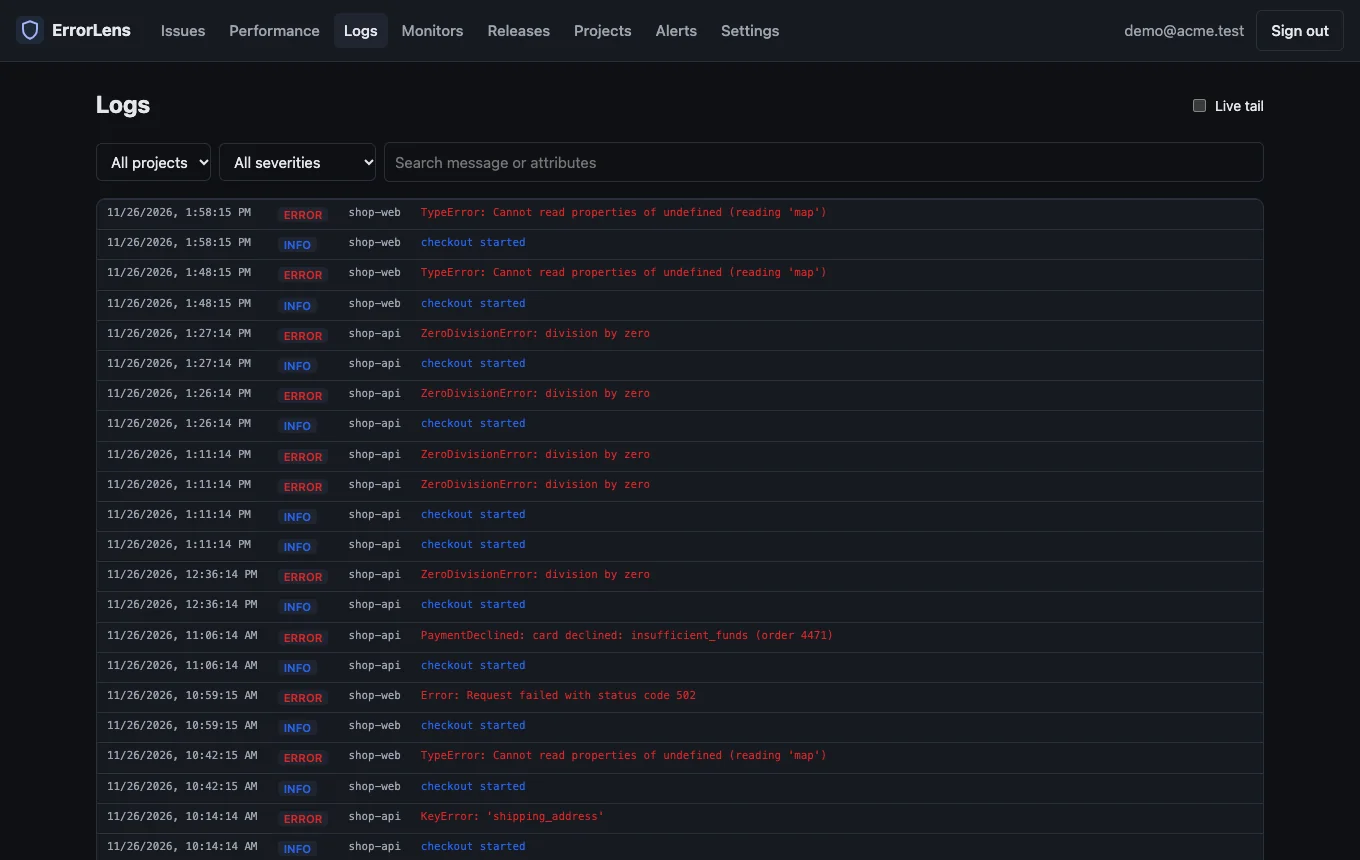
Collect structured logs from every service, search them by text or attribute, tail them live, and jump from any line to the request and errors around it.
Send logs
Python's standard logging records are sent too, and any language can ship logs with OpenTelemetry.
errorlens.init(dsn="https://<key>@errorlens.io/<project-id>", enable_logs=True)
errorlens.logger.info("Order {order_id} paid", order_id=42, amount=19.99)ErrorLens.init({ dsn: process.env.ERRORLENS_DSN, enableLogs: true });
ErrorLens.logger.info("Order {orderId} paid", { orderId: 42, amount: 19.99 });Find the line that matters
- Search message text and attributes; filter by severity, project, environment and release
- Placeholders like
{order_id}become attributes you can filter on - Live tail while you deploy or reproduce a bug
- Every line from a traced request links to its trace, errors and spans
Safe to log
Attributes named like secrets — passwords, tokens, API keys — are filtered in the SDK, and the server scrubs log bodies again before storing them. Old logs expire by day, so retention costs stay predictable.
Frequently asked questions
Is this a replacement for a full log pipeline?
For application logs, often yes: collection, search, live tail and trace links in the same tool as your errors. It isn't designed for infrastructure-wide log shipping from every host.
How long are logs kept?
30 days by default on the hosted service; on self-hosted installs you choose the retention.
Keep reading
An open-source backend for your OpenTelemetry traces and logs
An open-source OpenTelemetry backend: send traces and logs over OTLP/HTTP and get trace waterfalls, latency percentiles, log search and alerts. Self-host free.
Open-source APM that links slow requests to their errors and logs
Open-source application performance monitoring: p50/p95 latency, throughput, failure rate and distributed traces linked to errors and logs. Self-host free.
Open-source error tracking that finds the bug, not just the log line
ErrorLens is open-source error tracking and monitoring: grouped issues, stack traces with source context, alerts and releases. Free to self-host or hosted.
Logs docs
Start tracking errors in minutes
Free hosted plan with 5,000 errors a month, or self-host with no limits. No credit card.